Blog Detail
How RFID Jewelry Tags & Tracking Systems Are Transforming Jewelry Inventory Management
 " alt="blogDetail">
The management of jewelry inventory has always called for an extremely precise approach because every single item in the inventory is small, costly, and often varies in terms of weight, purity, gem type, and design. Even a small counting mistake can lead to major problems in the business, especially in retail shops that handle hundreds of pieces of merchandise moving in and out of display counters, trays, billing counters, and security vaults every day.
For many jewelry retail and wholesale businesses, the use of the barcode system helped in basic inventory management, but it still has limitations, especially in terms of requiring line-of-sight scanning and individual handling of each item in the inventory. This can already be a problem during peak sales, inventory, and other updates. The retail industry today needs a more efficient and intelligent system that can help in increasing speed without affecting product handling.
What Are RFID Jewelry Tags?
Jewelry stores require tags that are small enough to fit small products and strong enough to securely hold the digital product information. The RFID jewelry tags are designed for such purposes and are helpful in managing the products without scanning them individually by RFID readers.
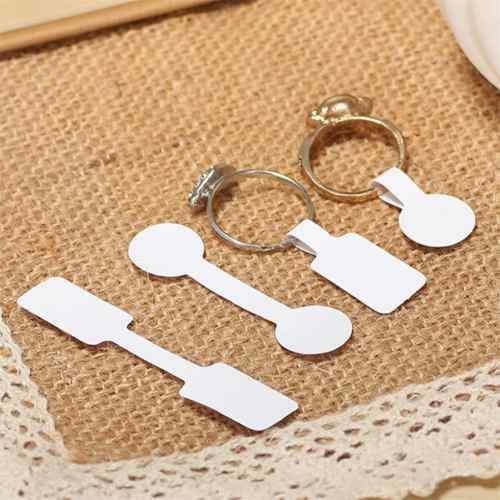
Jewelry RFID tags are small electronic devices created for precious items such as rings, earrings, pendants, bangles, and necklaces. The device is different from regular labels and helps in automatic product recognition from a short distance by sending radio waves.
Types of RFID Jewelry Labels: UHF, HF, and Passive Tags
Different businesses use different jewelry rfid tags for managing jewelry products, depending on the size of the store and the number of products to be scanned. UHF tags are commonly used for scanning a number of products at once, especially during the counting of the entire stock of the store.
HF tags are mostly used when controlled short-distance reading is a necessity, like in display counters, when individual product verification is a priority. Passive tags are mostly used due to their battery-free requirements and are activated when they are near a reader device.
How RFID Jewelry Tracking Works
A jewelry business can obtain the best benefits if the RFID tag functions together with the reader and the application in the entire tracking environment. An RFID jewelry tracking system enables the creation of an integrated process wherein every single item can be automatically identified, located, and tracked.
This technology enables the business personnel to avoid checking the stocks manually while enabling the management to obtain real-time visibility in the counters, storage rooms, and dispatch areas.
Components of an RFID Jewelry Tracking System
RFID Tags
Each jewelry product is assigned an RFID tag with its digital product identity. It remains associated with the product data stored in the inventory system.
RFID Readers
RFID readers receive the signals sent by the RFID tag and send the data instantly. Handheld RFID readers can be used to scan the tray with the items, while fixed readers can be employed to track the movement through the doors and counters.
Software System
The software is like a control center where information is stored, movement is recorded, automatic updates are made, and reports are generated.
Key Features of an RFID Jewelry Tracking System
A good RFID solution will help jewelry businesses handle stock better and in a more controlled fashion.
Real-Time Inventory Visibility
Using RFID technology, any product bearing an RFID tag will be scanned and identified in an instant. This will help store employees quickly determine if a product is in stock, on display, or already sold.
Bulk Scanning Capability
One of the most important advantages of RFID is that it will enable the scanning of multiple products simultaneously. This will greatly help the store save time during regular stock checks by scanning trays of rings, earrings, and chains all at once.
Anti-Theft and Security Features
By strategically placing RFID readers in key areas of the store, any kind of theft of jewelry will be detected if an RFID-tagged product leaves a key area of the store without authorization.
Integration with POS/ERP Systems
RFID systems can easily connect to billing and inventory management software. When a sale is made, the stock level information is automatically updated, reducing the likelihood of errors in reporting information.
Benefits of RFID Jewelry Inventory System
The RFID jewelry inventory system is a tool that helps jewelry businesses manage their stock levels with greater precision than traditional methods.
Improved Inventory Accuracy (Near 100%)
One of the main advantages of RFID is the high level of accuracy in stock verification. Each product is scanned and identified individually based on its RFID tag.
Faster Stock Counting
One of the most important advantages of RFID is that it allows a number of products to be scanned simultaneously. A whole tray of rings or necklaces can be scanned in a matter of seconds.
Reduced Shrinkage and Theft
Since the tagged items are always under observation, any missing items are identified sooner. If a piece of jewelry is moved incorrectly or not replaced in its original position, this system will help identify this problem sooner.
Better Customer Experience
The sales staff can retrieve any required piece of jewelry instantly, without having to look through the storage trays. This will enhance the quality of service, enabling customers to make buying decisions sooner.
RFID Jewelry Tags vs Barcode Labels
RFID and barcode labels can both be used for inventory control. However, RFID can be more efficient for jewelry businesses with valuable items to control every day.
Speed Comparison
Barcode labels involve scanning individual items one by one. In contrast, RFID technology can scan several items at once. It is much faster to work with inventory.
Accuracy Comparison
RFID technology is more accurate because it can scan items even if they are not lined up. Barcode labels may not work if the labels are bent, hidden, or damaged.
Cost vs ROI
RFID technology is initially more costly. Nevertheless, businesses can recover the cost because it saves time and minimizes inventory loss.
Long-Term Scalability
RFID technology can efficiently work with a growing inventory. It can easily work with a larger inventory compared to barcode technology.
Use Cases in the Jewelry Industry
RFID technology is now widely used in various segments of the jewelry industry due to its support for security and speed in inventory.
Retail Jewelry Stores
In retail jewelry stores, RFID technology is used for managing display counters, daily stock, and billing.
Warehouses and Distribution Centers
In storage facilities, RFID technology is used for tracking shipments, movement of trays, and interlocation movement of stock.
Luxury Jewelry Brands
For luxury brands, RFID technology is used for security and traceability of high-end products.
Exhibitions and Trade Shows
For exhibitions, RFID technology is used for tracking jewelry on display in a quick and secure manner.
How to Choose the Right RFID Jewelry Solution
The choice of a proper RFID solution is critical since a business in the jewelry industry needs a solution that suits both their handling needs and their long-term inventory needs.
Tag Type and Durability
The first aspect in selecting a proper RFID solution is selecting tags that are small, lightweight, and strong enough to withstand the handling of delicate pieces of jewelry.
Frequency (UHF vs HF)
The choice of frequency is based on business requirements, as UHF is used in bulk scanning and HF is used in scanning.
Software Compatibility
The RFID solution should be compatible with existing billing software, inventory management software, or ERP software, which is useful in automated inventory level management after every sale or movement.
Budget and Scalability
The business needs a solution that fits their budget while having a chance to expand in the future, as a scalable RFID solution will increase in value with increased inventory levels.
Challenges and Considerations
Even though there are significant advantages in using RFID technology, there are some practical difficulties involved in adapting to RFID technology.
Initial Investment Cost
One cost associated with RFID technology is the cost of tags, readers, and software.
Technical Setup
It is important to set up readers and software correctly to scan inventory.
Staff Adaptation
It might take some time for employees to adapt to automated inventory management.
Data Security
As inventory information is in digital form, there is a need to protect data access.
Future Trends in RFID Jewelry Tracking
The evolution of RFID technology is ongoing, and it is becoming more intelligent for luxury inventory.
AI + RFID Integration
The integration of AI can help in analyzing the RFID inventory and make it more efficient in planning the inventory and identifying abnormal patterns.
IoT-Enabled Smart Stores
The IoT can help in tracking the inventory in real-time across multiple devices and counters.
Predictive Inventory Management
This can help in predicting the inventory based on the demand created by the customers.
Blockchain for Authenticity
The use of blockchain and RFID can help in authenticating the jewelry and building trust in the product.
Conclusion
From the use of RFID technology in speeding up the counting of stock to the control of theft, RFID technology has changed the way in which jewelry businesses handle their inventories. Moreover, RFID technology has changed the way in which jewelry businesses identify products.
For a modern jewelry business, RFID is not just a technology upgrade but a competitive advantage. A modern jewelry business that utilizes smart tracking technology is better positioned to handle high-value products and scale its operations efficiently. TopTag Technology Co Ltd also reflects how advanced RFID systems can support jewelry retailers looking for reliable inventory management and long-term scalability.
FAQ
Q. What are RFID jewelry tags used for?
RFID jewelry tags are used to identify and track jewelry items digitally. They help businesses monitor stock, verify product movement, and perform inventory checks more quickly than manual methods.
Q. How accurate is RFID jewelry tracking?
RFID jewelry tags are used in identifying and tracking jewelry electronically. This helps businesses keep track of their inventory, check product movement, and carry out inventory checks.
Q. Is RFID better than barcode for jewelry inventory?
Yes, RFID is often better for jewelry inventory because it scans multiple items at once and does not require direct line-of-sight like barcode systems.
Q. What is the cost of an RFID jewelry inventory system?
The cost depends on the number of tags, readers, software features, and business size. Initial investment may be higher than barcode systems, but long-term efficiency often improves return on investment.
Q. What is RFID in jewellery?
RFID in jewellery refers to using radio frequency identification technology to tag and track jewelry items for inventory control, security, and faster stock management.
Q. How to choose the best RFID jewelry tags and tracking system for your jewelry business?
The best choice depends on tag durability, frequency type, software compatibility, and future scalability. Businesses should match the solution with their store size and inventory volume.
Q. What are the benefits of using RFID jewelry tracking for small and large jewelry businesses?
Small businesses benefit from faster stock checks and reduced loss, while large businesses gain stronger inventory visibility, automation, and easier multi-location control.
Q. Why are RFID jewelry labels important for managing high-value jewelry inventory?
RFID jewelry labels help maintain accurate records of expensive products, improve security, and ensure that every item remains traceable throughout storage and sales operations.