Blog Detail
RFID Bin Tags: Benefits, Uses & How Waste Tracking Works
 " alt="blogDetail">
Waste collection has quietly become one of the most data-driven operations in modern city planning. Behind every truck route, every scheduled pickup, and every recycling report, there is now a small piece of technology working in the background: the RFID bin tag. If you have ever wondered what is an RFID tag on a bin and why so many municipalities and private waste contractors are switching to it as part of broader smart waste management efforts, this guide walks through the whole picture.
RFID, or Radio Frequency Identification, has been used in logistics and inventory management for decades. Waste management is a newer but fast-growing application, as cities face pressure to cut costs, meet recycling targets, and prove regulatory compliance. RFID waste management gives them a practical way to do that without extra staff or paperwork. This shift is part of a wider wave of waste management technology reshaping city operations, with waste collection RFID systems now becoming standard practice rather than an experiment.
This blog covers what is an RFID tag on a bin, how the technology works from tag to database, the different tag types available, the benefits and real-world applications, and how to pick the right tag for your operation, along with a look at what the next few years are likely to bring.
What Is an RFID Tag on a Bin?
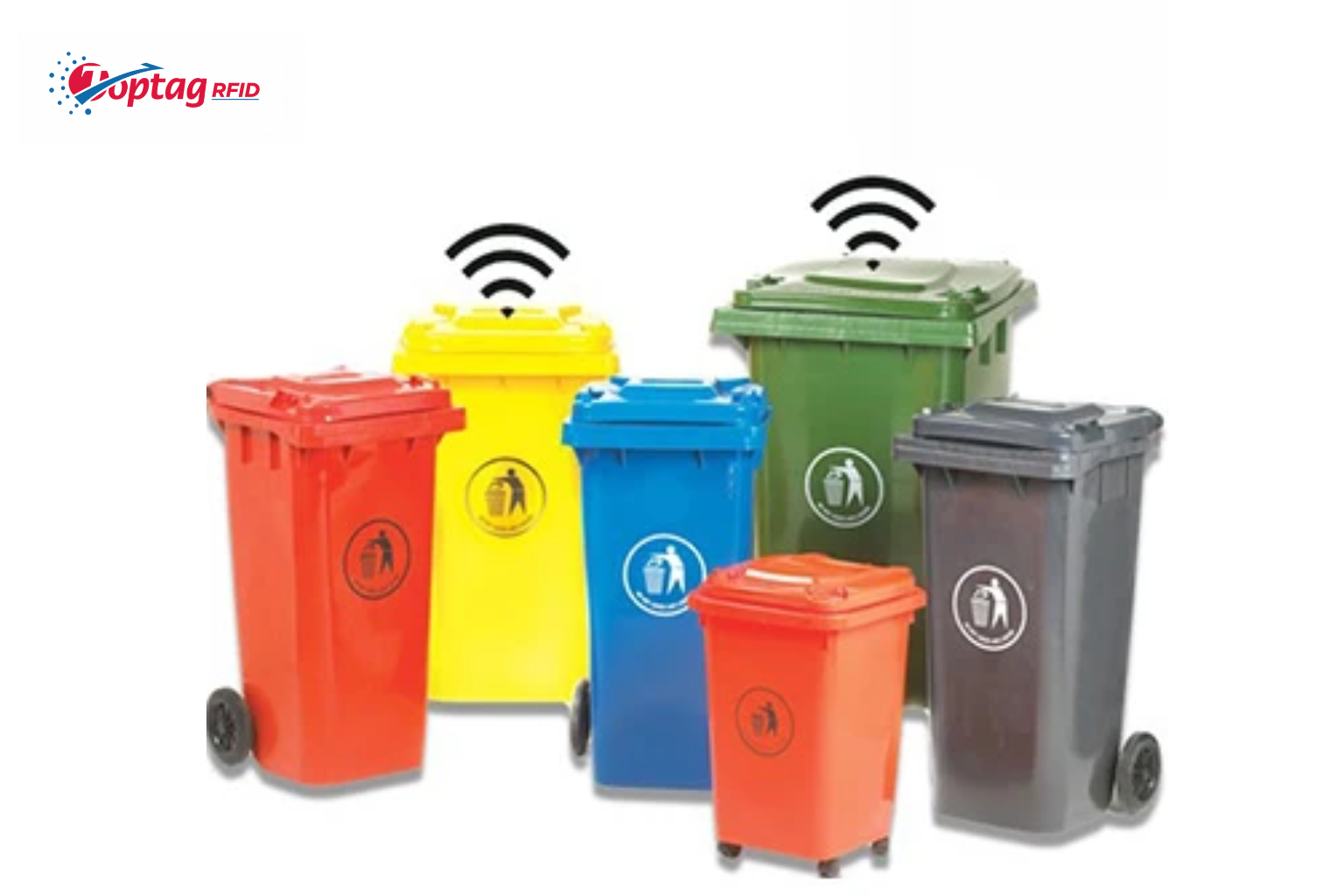
An RFID bin tag is a small electronic device, usually built from a chip and an antenna encased in a durable shell, that gets fixed onto a waste bin so the bin can be identified electronically. Unlike a barcode, which needs a direct line of sight, this tag can be read from a short distance using radio waves, even if it’s dirty, wet, or partially obscured. This is the simplest way to explain what is an RFID tag on a bin to anyone new to the technology, and it’s exactly why the identification happens in seconds rather than minutes.
Physically, it’s attached using a threaded mounting structure that fits into the bin’s lid or body. Most designs are compact and low-profile, so they don’t interfere with tipping mechanisms on trucks, and once fitted, they stay in place for years, holding up against sun, rain, and temperature swings.
Purpose of RFID Bin Tags
Once you understand what an RFID tag on a bin is, its purpose becomes obvious — it exists to solve a handful of practical problems for waste operators:
1. Unique bin identification – Each tag carries a unique ID, so no two bins are ever confused.
2. Automated waste collection – Trucks fitted with readers log a pickup the moment the bin is lifted, with no manual entry.
3. RFID asset tracking – Operators can see how many bins are in circulation, where they’re located, and whether any are missing.
4. Service verification – Councils and businesses can verify a bin was collected on time, useful for disputes and audits.
How Does an RFID Bin Tag Work?
Knowing what an RFID tag on a bin is is only half the story — the real value comes from how the surrounding system works together.
Key Components of an RFID Waste Management System
A functioning RFID waste management system relies on five main parts:
1. RFID Tag – One of the RFID tags for bins mounted directly on the container, storing a unique identifier and sometimes bin type or capacity.
2. RFID Reader – Placed on the garbage truck or at any fixed location to capture the signals from the tags.
3. Antenna – Increases reading distance and enhances performance for mobile trucks.
4. Backend Software – Links bin number to either location or customer.
5. Cloud Database – Stores the history of previous collection operations.
RFID Waste Collection Process
Once waste collection RFID infrastructure is in place, the day-to-day process is straightforward:
1. The tag is attached to the bin during manufacturing or as a retrofit.
2. The truck’s reader picks up the tag’s signal as the bin is lifted.
3. Bin data — ID, location, and time — is recorded automatically, with no driver input.
4. That information is transmitted to the management system, often in real time.
5. Analyses and reports are produced, providing the management with insights into the functioning of the fleet.
Also Read: Complete Guide To RFID Readers, RFID Modules & Product Tracking Solutions
Types of RFID Tags Used on Waste Bins
Not all RFID tags for waste bins on the market function in the same way. The selection is contingent upon several factors including the frequency band, range of reading, and passivity/activeness of the tag.
Low Frequency (LF) RFID Tags
LF tags operate at around 125–134 kHz. They perform reliably near metal and liquids, but their read range is short, usually just a few centimetres, limiting their use as RFID tags for waste bins in fast-moving truck collection.
High Frequency (HF) RFID Tags
HF tags run at 13.56 MHz and provide a moderate read range with good data transfer speed. They’re common in access control and applications where readers sit close to the bin, such as manual scanning at a depot.
Ultra High Frequency (UHF) RFID Tags
UHF tags, operating between 860–960 MHz, are the most widely used option for waste bins because they support longer read distances — often up to 3 metres — and can be read as a bin passes a reader on a truck. This makes UHF the preferred frequency for large-scale deployments, which is why buyers sourcing a custom RFID waste bin tag for fleet-wide rollouts usually start here.
Passive vs Active RFID Bin Tags
Passive tags have no internal battery; they draw power from the reader’s signal and are cheaper, smaller, and require virtually no maintenance. Active tags have their own source of power for increased coverage; however, they are expensive and have a finite lifespan. Bin applications employ the passive tag due to the nature of the work which requires bins to be able to transmit signals when they are within proximity to the reader device.
Benefits of RFID Tags on Waste Bins
Implementing smart waste management brings tangible benefits, beginning from the basics:
1. Accurate Bin Identification: Each bin receives its own digital signature, which takes away any ambiguity and need for physical labeling.
2. Improved Route Optimisation: With timestamped collection data planners can identify underused stops and reduce unnecessary mileage across the fleet.
3. Reduced Human Errors: Manual data entry can have typing errors and missed entries. RFID scanning removes most of that risk by capturing data automatically.
4. Better Asset Management: Operators are aware of the number of bins out there that require replacement and their locations to avoid losses.
5. Real-Time Data Collection: Since the uploading is done at the time of collection, it is easier for management to check on the performance of their work all day rather than waiting for the end-of-the-day report. The RFID bin tracking in this case gives insights from real pickup performance.
6. Enhanced Billing Accuracy: The RFID bin tracking enables correct billing for any pay-as-you-throw service by charging customers only for services provided.
7. Increased Operational Efficiency: The combination of automated logging, routing, and asset tracking improves efficiency through decreased administrative tasks.
Applications of RFID Bin Tags
These use cases show that what an RFID tag on a bin is used for goes well beyond a single truck route:
1. Municipal Waste Collection: City councils manage large fleets and thousands of collection points while keeping accurate service records for residents.
2. Commercial Waste Management: Retailers, office parks, and shopping centres track service frequency and verify contractors are meeting agreed schedules.
3. Industrial Waste Tracking: Factories and manufacturing sites monitor hazardous or regulated waste streams to support compliance documentation, often as part of a broader RFID asset tracking program covering equipment as well as waste containers.
4. Hospital Waste Management: Medical facilities separate and trace clinical waste, which is critical for regulatory reporting and infection control.
5. University and Campus Waste Collection: Large campuses measure recycling participation and how effectively different buildings divert waste from landfill.
6. Residential Communities: Housing developments confirm collection completion and, in some cases, support usage-based billing for residents.
RFID Waste Management System Components
Together, these pieces make up the underlying waste management technology stack:
1. RFID Bin Tags: The starting point of the whole system — durable RFID tags for bins fitted to every container, each carrying a unique identifier.
2. RFID Readers Installed on Collection Vehicles: Mounted near the lifting mechanism, these readers capture tag data automatically without slowing down collection.
3. GPS Integration: Pairing tag data with GPS coordinates lets operators confirm not just that a bin was collected, but exactly where and when.
4. Waste Management Software: The platform that turns raw scan data into usable information — scheduling, route management, customer records, and billing all run through here.
5. Reporting Dashboard: A dashboard gives managers a visual summary of collection rates, missed pickups, and fleet performance from any device.
RFID vs Traditional Waste Collection
| RFID Waste Management | Traditional Waste Collection |
| Automatic identification | Manual data recording |
| Digital tracking | Paper-based recordkeeping |
| Real-time reporting | Delayed reporting |
| Greater accuracy | Higher risk of errors |
| Optimized collection routes | Fixed collection routes |
| Enhanced accountability | Limited traceability |
Challenges of RFID Waste Management
1. Initial Investment: Fitting a fleet with readers and tagging every bin requires upfront capital, which can be a barrier for smaller operators.
2. Infrastructure Requirements: Readers, antennas, and software all need proper installation, usually with support from an experienced provider.
3. Tag Durability: Bins face impact, chemicals, and extreme weather, so tags must withstand rough handling over years of daily use.
4. System Integration: Connecting the data to existing billing or fleet management software can require custom development work, particularly when sourcing a custom RFID bin tag built around a proprietary protocol.
5. Staff Training: Drivers and admin staff need a basic understanding of the system to troubleshoot issues like misreads or reader faults.
How to Choose the Right RFID Bin Tag
Now that you know what an RFID tag on a bin is, picking the right one comes down to a few practical factors.
1. Environmental Conditions: Consider temperature extremes and chemical exposure before selecting a tag material and rating.
2. Read Distance Requirements: If trucks read tags on the move, a longer-range UHF option will perform better than HF or LF.
3. Tag Material and Durability: Look for tags rated for impact resistance and long-term outdoor exposure, since a fragile tag needs frequent replacement.
4. Memory Capacity: Some operations only need a basic ID number, while others want location or history data stored directly on the tag.
5. Frequency Selection: Match the frequency to your reader infrastructure; mixing incompatible frequencies across a fleet creates complications.
6. Compatibility with Existing Systems: Check that the tag’s protocol works with your current software and hardware before committing to a large-scale rollout. If you’re ready to buy RFID waste bin tag stock, ask your supplier for samples so you can test compatibility before placing a bulk order.
Why Choose TopTag RFID Bin Tags?
Sourcing a dependable RFID bin tag for large-scale deployment means manufacturing quality matters as much as the technology itself. TopTag has been designing and producing RFID tags since 2008, from facilities in Hong Kong and Shenzhen. Here’s what sets these tags apart:
1. High-quality RFID manufacturing – Built and tested in-house, with strict quality control at every production stage.
2. A customisable RFID waste bin tag – Size, color, chip protocol, and memory capacity can all be tailored to your project’s requirements, so you can order a truly customized RFID waste bin tag rather than a one-size-fits-all part.
3. Durable and weather-resistant materials – Constructed from ABS and rated for -25°C to +120°C, with waterproof and corrosion-resistant properties.
4. LF, HF, and UHF RFID solutions – A full range of frequency options to match different collection and reading environments
5. OEM and ODM services – Flexible manufacturing for businesses that need branded or purpose-built tags.
7. Global supply capabilities – Shipping from Shenzhen, Guangzhou, and Nanning to international customers ordering at scale.
8. Compliance with international RFID standards – Built to work reliably across common global chip protocols.
Future Trends in RFID Waste Management
1. Smart Cities and IoT Integration: Tagged bins are becoming one node in a larger network of connected sensors.
2. AI-Powered Waste Collection: Machine learning models are starting to use historical scan data to predict which bins will be full on a given day, helping planners skip unnecessary stops.
3. Predictive Maintenance: Combining fill-level sensors with tag data lets operators schedule truck maintenance and bin replacements before failures cause disruptions, extending the value of every asset tracking investment already in place.
4. Sustainable Waste Management: Better tracking data supports more accurate reporting of recycling rates, helping organisations meet targets with verifiable numbers rather than estimates.
5. Data-Driven Decision Making: As historical data accumulates, waste authorities are shifting from reactive scheduling to proactive, data-backed planning across entire regions.
Conclusion
An RFID bin tag might be a small, unassuming piece of hardware, but it plays a central role in modern waste operations. By enabling accurate bin identification, automated collection records, and real-time reporting, RFID waste management systems help cities and businesses cut costs, reduce errors, and make smarter decisions. From municipal fleets to hospital waste tracking, applications continue to expand as more organisations choose reliable data over manual guesswork — and once you’ve seen what is an RFID tag on a bin enables end-to-end, it’s hard to imagine going back to paper logs.
If you’re planning to upgrade your waste collection process, choosing a well-built, custom RFID bin tag from an experienced manufacturer is one of the most practical first steps you can take toward a smarter, more accountable system. Whether you need a single pilot batch or you’re ready to buy RFID waste bin tag volumes for a full fleet rollout, working with a manufacturer that understands both the hardware and the operational side makes the transition far smoother.
Frequently Asked Questions
How do RFID bin tags work?
The RFID waste bin tag communicates with a nearby reader using radio waves. When a truck lifts the bin, the reader captures its ID and sends the data to a central system instantly.
Why are RFID tags used in waste management?
They remove manual record-keeping, reduce errors, and give operators real-time visibility into schedules, bin locations, and service history.
What information is stored on an RFID bin tag?
Depending on memory capacity, a tag can hold a unique ID along with bin location, collection time, and the party responsible for it.
What is the difference between passive and active RFID bin tags?
Passive tags have no battery and activate only when scanned, while active tags carry their own power source for longer range at a higher cost.
How do RFID tags improve waste collection efficiency?
By automating data capture, they cut administrative work, reduce missed entries, and give planners accurate data to optimise routes.
Which industries use RFID waste management systems?
Municipalities, commercial property managers, industrial facilities, hospitals, universities, and residential communities all use it in different forms.
How do I choose the right RFID tag for waste bins?
Consider your environment, read distance, durability, memory needs, and frequency compatibility before selecting a supplier.